

SURVEYS 2025
Survey
1) Survey on functioning and improvements to be made in the concerted electronic recipe
In April, two questionnaires were sent respectively to mutual insurance companies and doctors from insurance companies. In the first case it is sent directly by MUFACE to the people surveyed, in the second it is sent through the insurers ASISA and ADESLAS.
They refer to the satisfaction with the service in the communities where the SIREM recipe is implemented, as well as to the proposal of improvements in relation to it, with its use as a physician.
A summary of results will be published.
.2) Survey on Mutual Perception of MUFACE’s Digital Progress
On January 17, 2025, two questionnaires were launched to mutualists with the common thread of study the collective’s perception of MUFACE’s digital advances. After the implementation of the Plan Adelante 2021-2024, in which one of the main strategies is the digital transformation after the impulse that was the declaration of active mutualists as subjects obliged to electronic processing in the most used procedure, it was necessary to gather the opinion of the collective, before the ideation of new projects of extension of digitalization, always with attention to the digital divide.
Both surveys and their results are discussed below.
Survey 1. Scholarships for study
On the basis of the universe, made up of all the mutualists who have enjoyed a scholarship in 2024, a very large sample was decided to ensure randomness and to obtain a response rate sufficient for statistical significance. The sample created was made up of 562 mutualists from Madrid and Barcelona. From this sample, 130 responses were obtained (a response rate of 23.13%),
The questionnaire for the assessment of the processing of study grants is very simple and consists of a series of assessment questions about the procedure and the benefit itself.
The fundamental difference between the provincial services of Madrid and Barcelona is the fact that in Barcelona they have been processed in the same province while the Madrid dossiers were processed through Zamora's "collaborative management" . In other words, the amount of the aid, the channels for obtaining information are identical and, being a fully electronic submission procedure, the submission of the application for the aid is the same in both provinces. The only significant difference will be found in the processing and resolution of the file. In the case of Madrid, the file will be processed and resolved by another SP (Zamora) and, subsequently, the SP of Madrid will make the payment of the benefit.
The most interesting aspect is the assessment of the speed of the resolution, which goes before the simplicity of the request, the clarity and the amount. The difference between the valuation of one and the other is +0.63 in favor of Barcelona. The difference does not reach a point but, in any case, it is almost double the difference existing in the other phases of the procedure. In other words, we may think that mutualistic people may come to perceive the effects of their file having been processed in a relocated manner. However, it should be noted that the assessment is very high in both provinces (9.1 and 9.73 out of 10). Noteworthy is the assessment of the simplicity and clarity of the service when formulating the application (7,69 and 7,55 respectively). The least valued is the amount of the benefit (5,33)
On the other hand, the whole sample was also asked if you would like to be able to apply for the benefit in person at a MUFACE office: the result is that only a quarter (24.3%) would want to be able to do so. The data has been crossed by age (lower age, lower percentage) and province (higher in Barcelona than in Madrid), but the differences are not significant enough.
In any case, and given that when considering the possibility of presenting the application in person it is considered as a diversification of channels (that is, electronics would still be available), we can conclude that there is no perceptible demand in terms of going back on digitalization.
Survey 2. Satisfaction with electronic services and digital advancement.
The second questionnaire, related to digital progress, was aimed at the total universe, that is, the whole collective (more than one and a half million mutualists) so there was no other option but to make a sample.
Given the previous experience of MUFACE conducting general questionnaires, se Decided to make a sample of 20,000 individuals and the introduction of quotas for a correct provincial distribution. A systematic random sampling was carried out in two stages: first, a letter was drawn (the “L” was chosen) and then individuals whose first surname began with that letter were chosen to complete the sample of each province or autonomous city.
Finally 2,689 interviews were obtained (response rate of 13.45%). The final distribution by province is maintained in margins of +/- one point, except two provinces: Ávila (negative) and Barcelona (positive).
We can summarize the result in several sections:
1) Mutualistic people prefer to carry out their procedures through electronic means for their convenience and speed.
67.71% of the mutualists declare that they habitually carry out their procedures with MUFACE through the electronic headquarters or the mobile App, being the preferred form in all age groups, including those over 75 years old. (Figure)
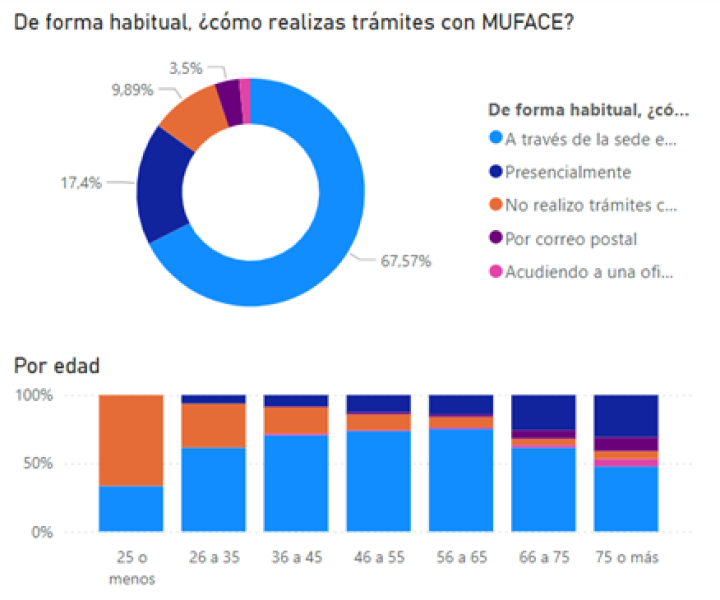
The main reason for using electronic media is its convenience (71.82%) and its speed (15.85%).
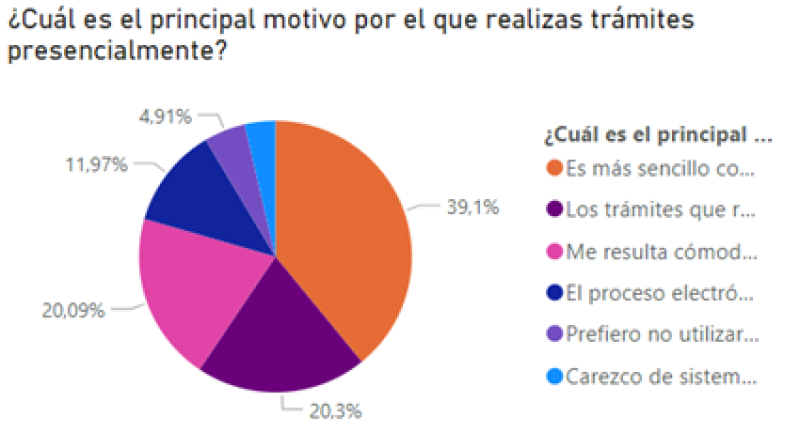
2) Most of the mutualistic people who come to the SSPPs They do so to obtain the help of an official or civil servant or because they do not have the possibility to carry out the procedure electronically.
17.4% of the mutualistic people carry out their procedures in the SSPP, mostly those over 65 years of age (55.12%). The main reasons for going in person are to obtain the help of a staff member in carrying out their procedure (39.1%), because the procedure is not available electronically (20.3%) or because it is convenient for them to go to the office (20.09%).
3) The attention in MUFACE offices has a positive assessment, but an improvement in telephone service is called for, as has already been shown in other surveys of the Mutuality
The assessment of the care received in the MUFACE offices of all the items obtained positive assessments in all of them (around 7 out of 10). In addition, they approve in all age groups, except for telephone attention that receives a touch of attention among children under 46 with a rating of only 4.87 (out of 10).
4) Digital services get very positive ratings especially among the elderly.
MUFACE’s electronic headquarters, mobile application and electronic information services get good ratings from mutual stakeholders. Especially noteworthy is the good performance of these tools among those over 65 years old, who value the tools above the general average and believe, for the most part, that the system is comfortable and fast (88.46%).
5) Mutualistic people They believe that it is vitally important to launch a digital recipe visa service And, to a lesser extent, the possibility of being personally attended to through video calls. This is in line with the permanent claim of the concerted electronic recipe and its extension to all the autonomous communities.
59.25% of mutualists consider it very important (9 or 10 out of 10) to launch a recipe visa service electronically. The average importance for the group of mutualists is 8.24 out of 10.
Although they believe in the importance (7.3 out of 10) of setting up a personal care service through video call (video appointment), only 39% give it the maximum importance.
6) Finally, the mutualistic people value positively the digital progress of MUFACE in the last 5 years, but ask to expand the available services and simplify them.
The process of digitalization that the mutuality has experienced in the framework of the Plan Adelante 2021-2024 obtains a remarkable (7.07 out of 10) among the mutualists and only 10.98% of them qualify it with suspense. The reasons why this digital advance is suspended include the need to expand digitally available services (31%), make the use of tools easier (24.9%) and improve the available information on procedures (13.47%).
The results of both surveys provide an impetus to progress digitally and continue on the path marked by the Progreso Plan 2021-2024. After the tractor element of the use of digital services that was in 2019 the declaration of subjects obigados to electronic procedure in the dental and ocular provision to active mutualists, it is clear that the perception of a broad majority of the collective is positive and that New digitization measures will be well received, as long as the digtal gap is addressed and the multi-channel approach is maintained for the elderly or with the need for a conventional channel, as well as face-to-face attention for urgent health or pharmaceutical issues for the entire mutualistic community.